The devil doesn’t always come wearing horns. Often, he comes wrapped in beauty, music, and distraction. That’s why Genshin Impact, one of the most popular games in the world, is so dangerous.
Beneath its colorful surface lies a steady stream of occult themes and outright demon names, taken from real-world witchcraft and demonology.
Christians cannot afford to ignore this.
1. The Archons — Demon Names on a Pedestal
At the heart of Genshin Impact are the Archons—the elemental gods who rule nations, bestow blessings, and shape the destiny of mankind. The entire game revolves around them. They are not side characters; they are the pillars of the story and the source of power in the game’s world.
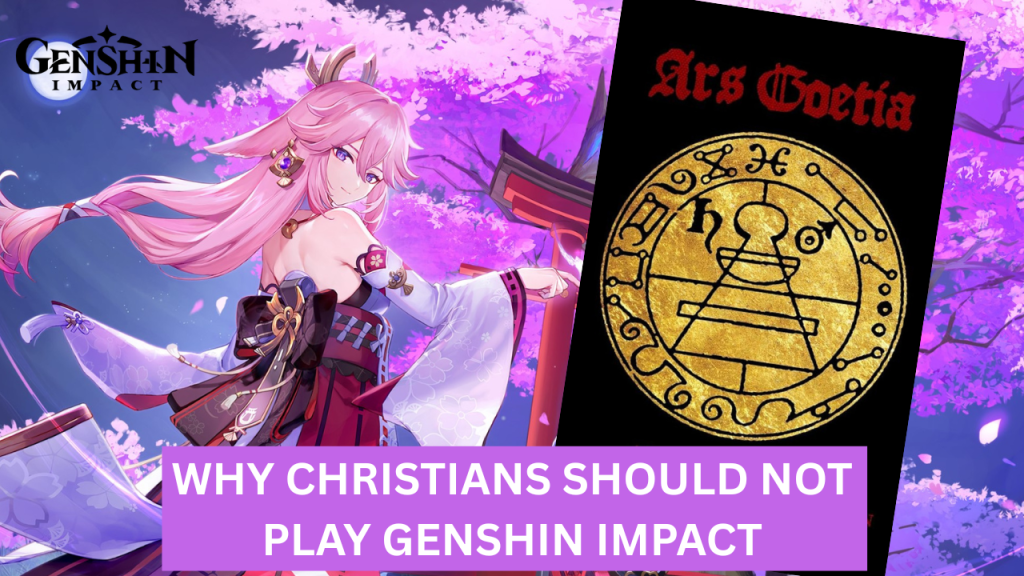
But here’s the chilling reality: the Archons do not bear invented fantasy names. They are drawn directly from the Ars Goetia, the first section of The Lesser Key of Solomon, a notorious medieval grimoire of demonology that instructs magicians on how to summon and command spirits.
This is not a coincidence. The developers deliberately chose these names—names that occultists for centuries have invoked in ritual. By weaving them into the game as benevolent gods, Genshin Impact takes real demons of hell and places them on digital pedestals to be admired, revered, and adored by millions of players.
The Breakdown
| Archon (Genshin) | Occult/Demon Name | Origin (Ars Goetia) |
|---|---|---|
| Venti (Anemo Archon) | Barbatos | 8th spirit, Duke of Hell. Grants knowledge of past and future, reconciles friends and rulers. |
| Zhongli (Geo Archon) | Morax | 21st spirit, Great Earl/President of Hell. Teaches astronomy and liberal sciences. |
| Raiden Shogun (Electro Archon) | Baal / Beelzebul | 1st spirit, King of Hell. Ancient false god of the Canaanites, mentioned in the Bible (1 Kings 18). |
| Nahida (Dendro Archon) | Buer | 10th spirit, President of Hell. Appears as a lion’s head with five goat legs; associated with philosophy and medicine. |
| Furina (Hydro Archon) | Focalors | 41st spirit, Duke of Hell. Associated with storms, drowning, and destruction. |
| Murata (Pyro Archon) | Aym (Aamon) | 22nd spirit, Marquis/Grand Duke of Hell. Brings discord, teaches occult sciences, and reveals hidden treasures. |
These aren’t harmless labels. These are the very seals and names used by sorcerers in rituals designed to invoke demonic power. Every time a player speaks of Barbatos, Morax, Baal, Buer, Focalors, or Aym in admiration, they are unknowingly repeating names that have been used in summoning rites for centuries.
Why This Matters So Much
God has always warned His people not even to utter the names of false gods as objects of reverence:
“Make no mention of the names of other gods, nor let it be heard on your lips.” (Exodus 23:13)
Why? Because names carry weight. To exalt a name is to acknowledge it. To normalize a name is to plant it in the imagination. And to celebrate the name of a demon, even unknowingly, is to participate in a subtle form of idolatry.
The Ancient Lie Repackaged
This is the oldest deception in the book—literally. Baal, one of the Archon names, was worshiped in the Old Testament as a storm god. Israel was constantly tempted to turn from Yahweh to Baal, offering sacrifices for rain and fertility. The prophets denounced this worship again and again, declaring that Baal was not a god but a demon leading people away from the Lord.
Now, in Genshin Impact, Baal returns—not as a villain to be resisted, but as a noble, majestic figure to be admired and served. The same demon Israel was commanded to flee is now being glamorized in glowing animation.
The Real Spiritual Risk
This is not harmless fantasy worldbuilding. It is rebranding demons as heroes. Millions of players worldwide are being taught to speak, admire, and even worship these names in the context of gameplay. What once was reserved for occult grimoires is now mainstream entertainment.
Paul’s words ring loudly here:
“The sacrifices of pagans are offered to demons, not to God, and I do not want you to be participants with demons.” (1 Corinthians 10:20)
By playing, admiring, and repeating these names, even casually, players are participating in the normalization of demonic reverence. That is no small thing.
The Bottom Line
The biggest red flag of all in Genshin Impact is not just the shrines, the circles, or the astrology—it’s that the very gods of the game are real demons dressed up as saviors.
That alone should make every Christian pause, turn the game off, and walk away.
2. Shrines, Temples, and Pagan Rituals
One of the most striking features in Genshin Impact is the presence of shrines and statues dedicated to the Archons. These aren’t just set-dressing. They are integral to the story and to the player’s progression. Characters kneel before statues, gain blessings, and unlock new powers by communing with them.
Shinto and Buddhist Parallels
These “Statues of the Seven” are unmistakably modeled after Shinto shrines in Japan and Buddhist temples in China. The architecture, the offerings, the glowing energy flowing from the idols—it all mirrors real-world spiritual practices where people leave food, money, or prayers for protection and favor from spirits.
In fact, many players who visit shrines in-game remark on how serene, holy, or beautiful they feel. That’s intentional design. It trains the eye and heart to see idol worship not as dangerous rebellion against God, but as something majestic and inspiring.
The Player’s Role
In gameplay, the shrines serve as waypoints, sources of power, and places of renewal. When you approach a shrine, your character receives strength, healing, or elemental empowerment. This is not a neutral action. It is the digital reenactment of idolatrous worship: bowing before a statue and receiving life from it.
Scripture warns us:
“Their idols are silver and gold, made by human hands. They have mouths, but cannot speak, eyes, but cannot see. Those who make them will be like them, and so will all who trust in them.” (Psalm 115:4–8)
In Genshin Impact, the exact opposite message is preached: the idols do see, do hear, and do bless you. That is the spiritual lie hidden in the mechanics.
Offerings and Blessings
Some in-game shrines require offerings to unlock blessings or powers. This mirrors the very essence of pagan ritual—give to the idol, and it will give back to you. The act of transactional worship (sacrifice for favor) is baked into the storyline, echoing both ancient pagan temples and modern occult practice.
God calls this an abomination.
“Do not worship any other god, for the Lord, whose name is Jealous, is a jealous God.” (Exodus 34:14)
The Subtle Danger
Here’s the real danger: Genshin Impact makes this entire process look good. It is presented in glowing light, serene music, and uplifting atmosphere. Young players in particular are taught that shrine worship feels safe, comforting, and rewarding.
But what God calls idolatry and warns will bring destruction, the game presents as holy and empowering. That’s not an accident—that’s inversion.
3. Sigils, Circles, and Occult Geometry
One of the most overlooked but spiritually dangerous aspects of Genshin Impact is its constant use of glowing runes, summoning circles, and elemental sigils. These designs aren’t filler art—they carry specific meanings rooted in real-world occult practice.
What Are Sigils and Circles?
In witchcraft and ceremonial magic, a sigil is a symbol designed to represent a spirit or a desired outcome. These are often inscribed during rituals to focus intent and call on supernatural powers. Similarly, summoning circles are geometric patterns (stars, triangles, pentagrams, and layered circles) drawn to create a “safe” boundary for conjuring demons or spirits.
In the Ars Goetia itself (the same book that gave the Archons their names), each demon is represented by a unique seal or sigil. To summon or command that demon, the magician would inscribe the seal within a circle and perform incantations.
Now compare that to Genshin Impact: characters unleash elemental powers through glowing seals, bosses emerge from intricate summoning circles, and runes light up on the battlefield to channel supernatural energy.
The parallels are too close to ignore.
Examples in the Game
- When activating elemental skills, runes flash underfoot, forming circles eerily similar to Wiccan ritual diagrams.
- Boss arenas feature layered geometric designs—circles within circles, triangles, and arcane patterns straight out of grimoires.
- Certain characters, when using their ultimate powers, are surrounded by rotating seals of light—visual stand-ins for magical invocations.
These designs don’t come from nowhere. The developers pulled them from alchemy, astrology, and occult magic traditions.
Why It’s Spiritually Dangerous
Even if a player never intends to practice the occult, repeated exposure to these visuals has a dulling effect. What once was shocking—an occult circle carved on a floor, a summoning ritual—becomes normal. What was once seen as dangerous starts to feel aesthetic.
And when occult practice looks ordinary, stylish, and fun in a game, how much easier is it for someone to dismiss its seriousness in real life? That’s desensitization in action.
Scripture warns us not even to imitate the practices of those who seek power apart from God:
“There shall not be found among you anyone who…practices divination or tells fortunes or interprets omens, or a sorcerer.” (Deuteronomy 18:10)
Yet in Genshin Impact, the very mechanics of battle—the core gameplay loop—are built on imitations of those same forbidden practices.
The Inversion of Worship
What God condemns as detestable, the game portrays as dazzling. Instead of prayer to God, players “channel” through circles. Instead of the seal of the Holy Spirit, they are marked by runes of power. Instead of light flowing from Christ, it comes from sigils designed in the shape of occult seals.
That’s the danger—not that players will suddenly start drawing pentagrams, but that their hearts will be conditioned to see the occult as harmless and even beautiful.
4. Spirit Possession as Power
In Genshin Impact, characters don’t simply “use” elemental forces like tools. Instead, they channel them through their very bodies. Their eyes blaze, their skin glows with supernatural markings, and their voices resonate with unnatural tones. What looks like heroic transformation is, in essence, a stylized version of spirit possession.
Mediumship in the Real World
In shamanism, witchcraft, and occult practice, mediums deliberately invite spirits to enter them, believing that these entities will grant insight, healing, or supernatural power. The practitioner becomes a vessel, their body no longer fully their own. In some traditions, this is even celebrated as a sacred union with the spirit world.
The reality, however, is darker: this is not empowerment, but bondage. Those who open themselves to such practices invite demonic influence that defiles and destroys.
Scripture does not mince words:
“Do not turn to mediums or seek out spiritists, for you will be defiled by them.” (Leviticus 19:31)
Possession Portrayed as Heroism
In Genshin Impact, the very same imagery that has marked occult rituals for centuries is reframed as noble and thrilling. When a character unleashes their ultimate ability:
- Symbols flare across their bodies like brands of initiation.
- Eyes flash with unnatural light, mirroring trance states in shamanic rituals.
- Voices shift as if another being is speaking through them.
- Their movements often become frenzied or superhuman, echoing accounts of possessed mediums.
In real life, these are all classic signs of someone being controlled by a spirit. In the game, it’s glorified as the pinnacle of strength.
The Subtle Lie
Here’s the danger: what God defines as defilement, the game defines as empowerment. What He warns will enslave, the game presents as liberation.
The lie is ancient—straight from the serpent in Eden: “You will not surely die…you will be like God.” (Genesis 3:4–5) The same promise of secret power apart from God is repackaged here in digital form.
Training the Imagination
Repeated exposure to this imagery reshapes how players think. Instead of associating possession with danger, darkness, and demonic influence, they learn to see it as cool, cinematic, and desirable. That is a slow but real form of conditioning.
Paul reminds us that the body is meant to be a temple of the Holy Spirit (1 Corinthians 6:19), not a vessel for elemental spirits or demons. Yet in Genshin Impact, characters embody the very opposite principle: temples for false powers.
5. Astrology and Constellations
In Genshin Impact, every character is tied to a constellation that defines their abilities, growth, and ultimate destiny. Unlocking pieces of these constellations through gameplay “reveals their true potential,” and players are taught that the stars themselves hold the key to power and advancement.
Astrology in the Real World
This is not innocent symbolism. It is textbook astrology—the ancient practice of divination through the stars. For thousands of years, people have looked to constellations and celestial alignments to predict fate, determine personality, and guide decision-making.
God’s Word is clear: this practice is an abomination. It replaces trust in the Creator with trust in created things. Instead of seeking the voice of the Lord, astrologers seek meaning in the heavens themselves.
Isaiah warned the Babylonians, a nation obsessed with astrology:
“Let your astrologers come forward, those stargazers who make predictions month by month, let them save you from what is coming upon you. Surely they are like stubble; the fire will burn them up.” (Isaiah 47:13–14)
The Subtle Teaching of the Game
By making constellations the literal blueprint for a character’s growth, Genshin Impact subtly reinforces the belief that fate is written in the stars. The underlying lesson is clear: your destiny, your abilities, and your identity are determined by cosmic forces beyond you, not by God who formed you.
This isn’t just creative storytelling—it’s indoctrination through repetition. Players become accustomed to the idea that the stars are the true authority over life.
The Biblical Contrast
Scripture paints the opposite picture:
- God made the stars, and they exist to declare His glory (Psalm 19:1), not dictate human destiny.
- Our days are written in His book, not in the constellations (Psalm 139:16).
- True guidance comes from the Word of God, not the alignment of stars (Psalm 119:105).
Why It Matters
When young players grow up repeatedly associating identity and power with constellations, they are being trained to accept astrology as normal. What once was condemned as occult divination is reframed as fun character progression. That makes real-world astrology more appealing, less threatening, and easier to dabble in—just as the enemy intends.
6. Why This Is More Dangerous Than “Just Fiction”
The issue with Genshin Impact is not that it’s a fantasy story or an anime-styled adventure. Christians don’t need to run from every piece of fiction. The problem is that this game takes real-world occult practices, demon names, and pagan rituals and packages them as entertainment.
The Slippery Slope of Familiarity
Here’s the progression:
- At first, it’s shocking. Shrines, sigils, demonic names—most players don’t recognize them, but if they did, they might recoil.
- Over time, exposure makes them familiar. Players see the imagery daily, and it stops feeling strange.
- Once familiar, it begins to feel normal. Idols, occult circles, and astrology become just another part of the background.
- And when it’s normal, hearts grow numb. What once would have been recognized as spiritual poison is now consumed as harmless fun.
This is exactly how the enemy works: not by jumping out with a pitchfork, but by desensitization.
“For Satan himself masquerades as an angel of light.” (2 Corinthians 11:14)
Satan rarely tempts people with things that look ugly or terrifying. Instead, he wraps rebellion in beauty, music, and wonder. Genshin Impact is one of his modern disguises—making idolatry look beautiful, sorcery look heroic, and demons look like friends.
Fiction That Points to Darkness
Plenty of stories use fantasy without glorifying the occult. The difference is whether the fiction points upward or downward. In Tolkien’s Lord of the Rings, power apart from God is shown to corrupt, and light is shown to overcome darkness. In Lewis’s Chronicles of Narnia, the whole story points to Christ.
But in Genshin Impact, the very opposite occurs:
- Idolatry is the path to blessing.
- Shrines are sources of power.
- Demons are renamed as gods.
- Possession is celebrated as strength.
- The stars, not God, dictate destiny.
This is not neutral fantasy. It is spiritual counterfeiting.
The Silent Catechism
Every hour spent in this world is an unspoken catechism in the occult. Without realizing it, players are being trained in rituals, imagery, and worldviews that belong to Satan, not to Christ.
That is why this is far more dangerous than “just fiction.” It doesn’t stay on the screen. It seeps into the imagination, the heart, and the habits of the player until the occult feels comfortable, even beautiful. And once it feels beautiful, the trap is sprung.
Conclusion: Flee from Idolatry
Christians are not called to walk as close to the line as possible—we are called to be set apart, to live in holiness, and to guard our hearts. Playing Genshin Impact is not just harmless fun. It means immersing yourself in a world of shrines, spells, sigils, astrology, spirit possession, and, most shockingly, the very names of demons catalogued in occult texts.
Paul’s command leaves no wiggle room:
“Therefore, my dear friends, flee from idolatry.” (1 Corinthians 10:14)
Notice the language—flee. Don’t linger near it. Don’t analyze it. Don’t flirt with it. Run from it.
- Don’t excuse it as “just fiction.”
- Don’t defend it because “everyone else plays it.”
- Don’t compromise by saying “it doesn’t affect me.”
Idolatry always affects us. The more we tolerate it, the duller our discernment becomes. The more we let it entertain us, the more we invite numbness into our spirit.
So delete it. Put it away. And don’t stop there. Replace it. Fill that reclaimed time and mental space with prayer, with Scripture, with creativity and pursuits that glorify God. Choose worship over wandering, truth over imitation, and Christ over counterfeit.
What you lose in pixels, you will gain in presence. What you set aside in false gods, you will gain tenfold in the living God. And what once enslaved you with digital beauty will be replaced with the eternal beauty of holiness.
About the Author
I write at the crossroads of faith, leadership, and storytelling. If this reflection spoke to you, I invite you to explore my books — works that aim to equip, encourage, and challenge believers to live with courage and conviction.
- [Command Presence: Tactical Guide for Life & Leadership] – lessons from law enforcement applied to everyday resilience.
- [Faith & Focus Devotional] – daily encouragement for grounding your spirit in Christ.
- [Sacred Ground: Bloody Knuckles] – stories of struggle, grit, and redemption.
You can find them here or at the links above.
 Being Sanctified
Leave a comment