
The Question We Refuse to Answer
There are few evils in human history more dependent on dishonesty than abortion.
It survives not because the truth is hard to find, but because the truth is hard to face. So we bury it beneath euphemism. We drown it in slogans. We wrap it in politics, therapy, autonomy, rights-talk, fear, sentimentality, and sterile medical language. We rename the act so that the conscience does not have to look at it directly. We call it reproductive freedom. We call it healthcare. We call it compassion. We call it a personal decision. We call it a difficult choice.
We call it almost everything except what it is.
And that is the first sign that something is deeply wrong.
When a society cannot tell the truth plainly about bloodshed, it is not because the issue is too complicated. It is because clarity would cost too much. Clarity would demand repentance. Clarity would demand justice. Clarity would demand that millions of people—politicians, activists, doctors, voters, pastors, parents, boyfriends, judges, and ordinary citizens—admit that what they defended, funded, tolerated, justified, or ignored was not a tragic medical procedure in a broken world, but the intentional killing of innocent human beings.
That is not a comfortable truth. But comfort has never been the measure of whether a thing is true.
This book is built on a question that modern society will do almost anything to avoid answering honestly: What is abortion?
Not what does it feel like. Not how does it poll politically. Not what hard cases can be used to muddy the waters. Not what slogans sound empowering in a protest chant. Not what line can be repeated often enough to numb the conscience.
What is it?
That question comes before strategy. It comes before party loyalty. It comes before legal theory, before polling data, before electoral compromise, before emotional manipulation, before personal narrative, and before all the machinery of euphemism designed to make moral clarity seem cruel.
Because if abortion is the intentional killing of an innocent human being, then everything changes.
If abortion is the intentional killing of an innocent human being, then it cannot be defended as healthcare. It cannot be excused as choice. It cannot be hidden behind autonomy. It cannot be normalized as a private matter. It cannot be treated as a necessary social good. It cannot be regulated as though the problem were merely that too many happen. It cannot be approached as a regrettable but legitimate option in a pluralistic society. It cannot be protected by law without the law itself becoming an accomplice to injustice.
If it is murder, then justice does not permit us to speak of moderation. Justice does not ask how to make murder safer, rarer, more sterile, or more politically manageable. Justice demands that the innocent be protected. That is what justice is for.
And that is why this book is not merely pro-life in the modern, softened, politically marketable sense of the term.
It is abolitionist.
That distinction matters.
The modern pro-life movement has often done real good by exposing abortion, restricting it, and rescuing some children from death. But it has also too often spoken with a split tongue. It has said abortion is murder while treating it as a matter for gradual regulation. It has said the unborn are children while building legal strategies that stop short of demanding equal protection for them. It has condemned the act while shrinking back from the full implications of what such condemnation requires in law, politics, and public morality.
But if the unborn child is truly a human being—and he is—then he is not entitled to some lesser category of concern. He is not owed sympathy without protection, rhetoric without rescue, or tears without justice. He is owed what every innocent human being is owed: the protection of the law and the recognition of his full humanity.
Anything less is moral theater.
This book argues that abortion must be abolished because abortion is the intentional killing of innocent human beings, and the intentional killing of innocent human beings is the kind of act that justice must confront, name, prohibit, and punish. That argument is not built on one pillar alone. It is built on four.
First, biology. The child in the womb is not a potential human being, but a human being with potential. From the moment a new human organism begins to exist, what exists is not a blob, not a body part, not a mystical possibility waiting to become real, but a living, developing, distinct member of the human family. He does not become human later because he grows larger, more visible, more wanted, more self-aware, or more capable. He is human from the start. What changes is not his nature, but his stage of development.
Second, philosophy. Most defenses of abortion depend on standards of human value that are arbitrary, unstable, and dangerous. Self-awareness, consciousness, viability, independence, wantedness, level of development—none of these can determine whether a human being may be intentionally killed without opening the door to excluding others as well. If human worth depends on size, strength, awareness, location, or social usefulness, then human equality is already dead. The only stable basis for equal human dignity is membership in the human family itself.
Third, law. Civil government is not God, and law cannot save the human heart. But one of the first duties of civil government is to protect innocent human life from unjust violence. A government that refuses to protect a class of innocent human beings is not being neutral. It is declaring that some lives may be lawfully destroyed for the sake of others. That is not liberty. It is legalized injustice. If the unborn are human beings, then equal protection of the laws is not an extreme demand. It is the bare minimum.
Fourth, Scripture and theology. The Christian case against abortion is not a thin emotional appeal to “value life” in the abstract. It is rooted in the reality that man is made in the image of God, that innocent blood cries out to Him, that God hates the shedding of innocent blood, that rulers are accountable for justice, that the strong are forbidden from devouring the weak, and that every society that calls evil good and good evil places itself in rebellion against the moral order of its Creator. Abortion is not merely a private choice. It is bloodguilt. It is rebellion baptized in the language of compassion.
That word—bloodguilt—will sound severe to modern ears. Good. It should.
We live in an age committed to verbal anesthesia. We are told that moral clarity is extremism, that strong categories are dangerous, that certainty is violence, and that the kindest thing we can do is blur every hard line until conscience is rendered too weak to judge anything at all. But there is nothing loving about refusing to name evil. There is nothing compassionate about obscuring the victim. And there is nothing humane about building a legal order that identifies the smallest and weakest humans on earth as disposable.
This book will not pretend the hard cases are not hard. It will address rape, incest, medical emergencies, coercion, abandonment, fear, poverty, despair, and the real anguish that surrounds many abortions. Only a fool or a coward would write about this issue as though human suffering does not exist. Human suffering does exist. It exists in the woman terrified and cornered. It exists in the girl abused and pregnant. It exists in the family panicking. It exists in the man who pressures and abandons. It exists in the doctor who has trained himself not to see. It exists in the culture that offers death as the solution to crisis.
But suffering does not have the power to turn evil into good.
That is one of the central lies of the abortion regime—that hardship can justify homicide, that fear can make the innocent killable, that trauma can erase personhood, that responsibility can be escaped by eliminating the vulnerable human life whose existence has become unbearable to others. Yet the moral law does not bend simply because obedience is painful. The fact that a choice is hard does not mean every option before us is moral.
The child in the womb does not become less human because his father was a rapist. He does not become less human because his mother is frightened. He does not become less human because money is tight. He does not become less human because his life will require sacrifice from others. He does not become less human because the culture calls him unwanted.
The issue is not whether crisis is real. The issue is whether crisis gives us permission to intentionally kill an innocent human being.
This book answers no.
And because it answers no, it also rejects one of the most common habits in modern discussions of abortion: the obsession with exceptions as a means of escaping the rule. A civilization that has authorized the routine killing of the unborn on demand for convenience, autonomy, fear, and self-interest has no moral right to hide behind its rarest and hardest cases. The hard cases matter. They should be handled carefully, truthfully, and with compassion. But they must not be used as emotional camouflage for a system whose ordinary functioning depends not on extreme tragedy, but on normalized selfishness, sexual irresponsibility, social cowardice, and the worship of personal autonomy.
That last point is crucial.
Abortion is not merely protected by bad logic. It is protected by a worldview. It rests on a vision of the self as sovereign, the body as private property, freedom as freedom from obligation, sex as detached from responsibility, and inconvenience as a kind of oppression. In that moral universe, the unborn child appears not as neighbor, but as invader. Not as son or daughter, but as obstacle. Not as one to be received, protected, and loved, but as one whose destruction can be justified by invoking the desires, plans, and stability of the stronger party.
That is not justice. It is power.
And that is one reason abortion is so revealing. It exposes what a culture truly believes about human worth. It reveals whether we believe rights belong to humans by nature, or whether they are permissions granted by those who already possess power. It reveals whether vulnerability increases our duty to protect, or decreases the victim’s claim to live. It reveals whether law exists to defend the weak or to stabilize the preferences of the strong. It reveals whether we truly believe in equal human dignity, or only in the dignity of those who are conscious enough, independent enough, wanted enough, and visible enough to force their way into the moral imagination of others.
Abortion is not the only evil in the world. But it is among the clearest tests of whether we still possess the moral eyesight to recognize evil when it wears a lab coat, speaks in therapeutic language, and asks only that we not look too closely.
This book is written for several kinds of readers.
It is written for those who already suspect abortion is deeply wrong but have never followed the logic to its legal and moral conclusion.
It is written for Christians who have said they are pro-life while quietly accepting a framework of compromise that they would never accept in any other matter involving the intentional killing of innocent people.
It is written for those who have repeated slogans they inherited from the culture without ever seriously examining the assumptions hiding beneath them.
It is written for men and women whose consciences are uneasy, even if they do not yet know why.
It is written for pastors who have avoided this issue because they fear division more than they fear silence in the face of bloodshed.
It is written for ordinary people who have been taught that the issue is simply too complex for clarity and who need someone to tell them, plainly, that the complexity has often been weaponized to protect the indefensible.
And it is written, too, for those who have been touched personally by abortion—those who have chosen it, encouraged it, paid for it, performed it, defended it, or remained silent while others did it. This book is a hard book, but it is not written to mock the guilty. It is written to tell the truth to them. Truth first wounds, and then—by the grace of God—it can heal. But nothing can be healed by lies.
So let there be no confusion from the beginning: this is not a book of sentimental outrage. It is not an appeal for political branding. It is not a call for softer rhetoric, better messaging, or more effective coalition-building around a slightly improved management of legal child-killing. It is not interested in finding the most marketable middle ground between justice and cowardice.
It is a call to tell the truth.
A call to say what abortion is.
A call to reject the language games, the legal fictions, the philosophical evasions, and the moral compromises that have made peace with it.
A call to demand equal protection for the child in the womb because he is one of us.
A call to the church to stop whispering where God has spoken.
A call to men to stop hiding behind women while pressuring, abandoning, or excusing the destruction of their own children.
A call to civil rulers to remember that neutrality in the face of targeted killing is not neutrality at all.
A call to a nation drunk on euphemism to sober up.
And above all, a call to remember that the smallest human beings are not abstractions. They are not political symbols. They are not “contents,” “products,” “tissue,” or manageable inconveniences standing in the path of someone else’s autonomy. They are children. To kill them intentionally is an act of grave injustice. To protect that killing is public evil. To excuse it is moral corruption. To tell the truth about it is the first duty of anyone who still wishes to speak honestly about justice.
Everything in this book follows from that.
If the unborn child is not human, no defense of abortion is necessary.
If the unborn child is human, no defense of abortion is enough.
That is the question.
And it is the question we have refused, for far too long, to answer plainly.
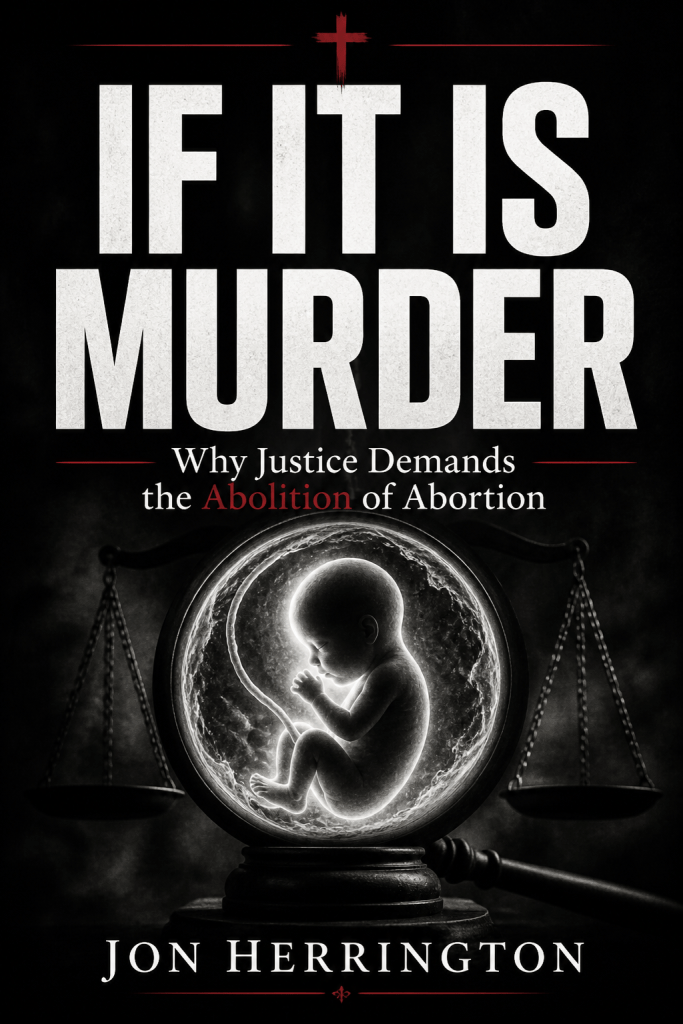
Hey, I’m Jon. I’m posting my new book, If It Is Murder: Why Justice Demands The Abolition Of Abortion, one part at a time here on my blog until it’s all published and freely available.
Once that’s done, I’ll put it up as a full book for purchase for anyone who wants it. Stay tuned here for the link to that!
God bless you all, and let’s get abortion abolished!
On a completely separate note, I like to chill and play Minecraft and worship Jesus. If you like those things, come hang out: https://discord.com/invite/77WVyNxCXY
If you’re a troll, don’t come hang out. You’ll just get banned anyway so why waste everyone’s time?


Leave a comment