
The Lie We Agreed to Call Compassion
Compassion is one of the most abused words in modern moral language.
It is invoked to bless cowardice, to excuse injustice, and to disguise the refusal to tell the truth. It is used as a shield against judgment, a substitute for moral reasoning, and a rhetorical weapon against anyone unwilling to join the culture in calling darkness light. Few words sound warmer. Few words are now used more often to make evil things appear humane.
Abortion is one of the clearest examples.
For decades, abortion has not merely been defended as a right. It has been defended as compassion. Compassion for the frightened girl. Compassion for the poor woman. Compassion for the mother of many children. Compassion for the victim of rape. Compassion for the woman whose future feels cornered by pregnancy. Compassion for the family in crisis. Compassion for those who simply are not ready.
The word is repeated so often, and with such emotional force, that many people never stop to ask the most obvious question: Compassion for whom?
That question matters because compassion is not a magic word. It does not become good merely by being felt strongly. It does not justify whatever action is taken in its name. It is not enough to point to pain. One must also ask what is being done in response to that pain, and whether that response is just.
To put it plainly: not every act motivated by sympathy is righteous. Sometimes sympathy becomes corrupt. Sometimes pity severs itself from truth. Sometimes the desire to relieve suffering becomes so impatient, so sentimental, and so morally undisciplined that it begins to justify things that should never be justified. There is a kind of compassion that comforts the afflicted, bears burdens, tells the truth, and protects the weak. But there is also a counterfeit compassion that solves one person’s crisis by authorizing violence against another.
Abortion belongs to the second category.
That is what makes the language surrounding it so revealing. The culture does not usually defend abortion by saying, “Yes, this is the intentional killing of a human being, but we think some human beings may be killed when their existence is too costly.” That would be too honest. It would be monstrous to say aloud. So instead we are offered softer language. We are told this is care. Relief. Mercy. Freedom. Dignity. A painful but loving choice. A responsible decision in a hard world.
And the euphemisms are endless.
We are told a woman is “ending a pregnancy,” as though pregnancy were some free-floating condition that can be removed without reference to the child whose existence makes her pregnant in the first place. We hear of “terminating a pregnancy,” as though the object terminated were not a developing human life but merely a difficult circumstance. We hear “reproductive healthcare,” a phrase so broad and polished it can hide almost anything beneath its white coat. We hear “women’s healthcare,” though no healthy organ is being healed, no disease is being cured, and no injury is being repaired. We hear “products of conception,” a phrase so sterile and bloodless it sounds like hospital waste rather than a son or daughter. We hear “fetal tissue,” “pregnancy tissue,” or “contents of the uterus,” all carefully chosen to keep the mind from seeing what the act actually destroys. Even the phrase “choice” functions as camouflage, shifting attention away from the object chosen and onto the supposed dignity of choosing itself.
It is hard to overstate how much moral work that language performs.
The human conscience does not like naked brutality. It recoils from direct statements of bloodshed. Most people do not want to think of themselves as defenders of the strong crushing the weak. They do not want to picture a child in the womb. They do not want to imagine a beating heart stilled, a growing body dismembered or destroyed, a life ended because someone else’s circumstances, desires, or fears made his continued existence intolerable. So the act is renamed. The victim is obscured. The moral frame is shifted. The question is moved away from the child and onto the adult. Away from justice and onto emotion. Away from what is being done and onto how difficult it feels for the person doing it.
That shift is the trick.
Once the entire discussion is centered on the fear, pain, or autonomy of the mother, compassion begins to mean one thing above all: helping her escape the burden in front of her as quickly and thoroughly as possible. And if the burden is a child, then the child becomes the object to be removed. Not neighbor. Not son. Not daughter. Not one of us. Just a crisis with a heartbeat.
This is why the abortion debate so often feels morally disorienting. It is not only that people disagree about facts or law. It is that the public language surrounding abortion has trained people to locate compassion almost entirely in the desires and distress of the stronger party, while the weakest party is hidden from view. The entire emotional architecture of the issue is arranged to make it seem cruel to defend the child and compassionate to destroy him.
That is not moral clarity. It is moral inversion.
The prophet Isaiah pronounced woe upon those who “call evil good, and good evil” and who “put darkness for light, and light for darkness.” That is not merely an ancient warning for ancient Israel. It is a permanent description of what moral rebellion does to language. Truth is not always denied head-on. More often it is blurred, softened, renamed, and rearranged until the conscience can live with what it once would have condemned.
That is what abortion rhetoric does. It does not merely justify an act. It trains the tongue to hide the act from the soul.
Scripture is relentless about this. “Open your mouth for the mute,” Proverbs says, “for the rights of all who are destitute.” Yet abortion culture does the exact opposite. It speaks endlessly for the powerful and never for the child who cannot speak at all. Proverbs also tells us that “he who justifies the wicked and he who condemns the righteous are both alike an abomination to the Lord.” A society that condemns those who defend unborn children as cruel while praising those who authorize their deaths as compassionate has not become morally advanced. It has become morally confused.
Real compassion never requires us to lie about the victim. Real compassion does not ask us to erase one human being in order to care for another. Real compassion does not solve hardship by eliminating the innocent person whose existence has become hard. Real compassion does not say, “This life is inconvenient, frightening, expensive, or painful, and therefore love permits us to end it.”
If that is compassion, then words have lost all meaning.
It is worth pausing here, because modern people have been catechized to think that moral seriousness and compassion are often opposites. We are taught that clear moral lines are harsh, while blurred lines are humane. That judgment is unkind, but affirmation is loving. That speaking plainly about evil is cruel, but covering it with therapeutic language is merciful. The effect is devastating. It means that anyone who refuses to rename evil is treated as the real offender. The one who says, “This is unjust,” becomes the villain, while the one who authorizes killing in the name of care is presented as enlightened and tenderhearted.
But tenderness detached from truth is not tenderness. It is sentimentality. And sentimentality is often more dangerous than open hatred, because it can make atrocity feel merciful.
History is full of examples of this kind of corruption. People are capable of astonishing cruelty when they convince themselves it is necessary, compassionate, enlightened, or protective. The language changes with the era, but the pattern stays the same. The victims are reduced, renamed, or hidden. Their full humanity is softened at the edges. Their destruction is framed as regrettable but beneficial, painful but necessary, tragic but compassionate. The conscience is lulled. The hands remain dirty, but the soul is told a nicer story about them.
That is exactly what abortion culture has done.
It has told women that the death of their child is healing. It has told men that abandoning responsibility can be reframed as respect for choice. It has told doctors that killing can be called care. It has told lawmakers that neutrality in the face of bloodshed is justice. It has told pastors that silence is gentleness. It has told ordinary citizens that not looking too closely is wisdom.
And above all, it has told society that the deliberate destruction of the smallest and weakest human beings can be placed under the banner of compassion if enough fear, pain, and euphemism are piled around it.
But no amount of surrounding pain changes the nature of the act itself.
This is where many people begin to resist. They hear language like this and immediately think of hard cases. They think of a terrified teenage girl. A woman pregnant after rape. A mother already stretched beyond what she believes she can bear. A diagnosis. A medical emergency. A collapsing relationship. A family in poverty. And because those situations are painful and real, they assume any firm moral language must be blind, simplistic, or cruel.
It is not.
Only fools speak of abortion as though suffering is unreal. Suffering is real. Panic is real. Coercion is real. Desperation is real. Shame is real. Trauma is real. Abandonment is real. But suffering, however real, does not have the power to transform injustice into justice. Fear does not turn killing into care. Pain does not make the innocent disposable. A crisis does not suspend the moral law.
The biblical witness is plain here too. God is not indifferent to affliction; He sees it, hears it, and judges those who exploit the vulnerable. But the God who has compassion on the suffering is also the God who hates “hands that shed innocent blood.” Scripture never asks us to choose between truth and mercy. It commands both. The modern abortion framework does something darker: it asks us to call the shedding of innocent blood an act of mercy itself. That is not biblical compassion. That is a blasphemous parody of it.
This is why the phrase “compassionate abortion” is ultimately a contradiction. It asks us to believe that an act can be merciful toward the vulnerable while it intentionally destroys one of the vulnerable. It asks us to call the removal of the weak a form of care. It asks us to imagine that love can be measured by how efficiently it eliminates the life that has become burdensome. That is not compassion. It is triage performed by moral cowards at the expense of someone who cannot speak.
And once that logic is accepted in one place, it never stays there neatly. Any society that learns to measure human worth by wantedness, burden, convenience, or projected suffering will not remain stable. Once we accept that some innocent humans may be killed because their existence creates serious hardship for others, we have already introduced the poison. We have already abandoned the principle that the weak must be protected precisely when they are weakest. We have already taught ourselves that vulnerability is not a claim upon our mercy, but a reason we may erase the vulnerable altogether.
That is one of the great lies at the heart of abortion culture: it calls the elimination of dependence compassion, when actual compassion would move toward dependence with sacrifice, truth, and protection.
The child in the womb is the most dependent human being imaginable. He cannot flee. He cannot protest. He cannot plead his case. He cannot survive separation. He cannot force himself into the moral imagination of those who want him gone. And because he is hidden, silent, and weak, he is easily recast as something less than our neighbor. But dependence does not erase humanity. If anything, it intensifies our duty. The more helpless the person, the stronger our obligation to protect him.
That is how love works. Or at least, that is how love is supposed to work.
A mother caring for a newborn who cannot feed himself is compassionate. A father sacrificing sleep, money, and comfort to protect his child is compassionate. A community surrounding a frightened woman with support so that she does not feel forced into destruction is compassionate. A church helping bear real burdens rather than merely condemning from a distance is compassionate. A doctor laboring to save both patients when possible is compassionate. A society structuring its laws around the defense of the innocent is compassionate.
But the intentional killing of a child because his life creates fear or hardship for others is not compassionate. It is the abandonment of compassion.
In many ways, the abortion debate is a debate about whether compassion will be governed by truth or severed from it. When severed from truth, compassion becomes indulgence, then corruption, then violence with a tearful face. When governed by truth, compassion remains tender without becoming treacherous. It can acknowledge agony without lying. It can move toward people in crisis without authorizing evil. It can say, “Your suffering is real, and you must not be abandoned,” while also saying, “Your child is real, and he must not be killed.”
That is the kind of moral clarity modern abortion rhetoric works tirelessly to prevent. Because once both mother and child are seen clearly, the whole emotional script begins to collapse. The lie depends on selective vision. One person’s fear must be made vivid; the other person’s humanity must be dimmed. One life must fill the frame; the other must remain blurry. That is how the word compassion is hijacked.
The issue, then, is not whether we should be compassionate. We should. The issue is whether compassion will mean helping the suffering without sacrificing the innocent, or whether it will mean giving the strong moral permission to destroy the weak whenever the burden of love feels too heavy.
There is no shortage of people eager to defend the second option. There are activists, institutions, politicians, media voices, and entire industries built around it. But the fact that a lie is profitable, popular, and emotionally effective does not make it less of a lie. It only makes it more urgent to expose.
And exposure begins with refusing false names.
Abortion is not compassionate because it happens in a context of hardship. It is not compassionate because someone cries before, during, or after it. It is not compassionate because the culture offers it gently. It is not compassionate because it is framed as necessary. It is not compassionate because the world has grown skilled at hiding the victim.
It is what it is.
A child is dead, and everyone involved is told to call that mercy.
That is not compassion. That is moral fraud.
And once the fraud is exposed, the next question crashes through all the euphemisms and all the tearful slogans with the force of a hammer: Who, exactly, is being killed?
Because once the language is stripped away, that question becomes unavoidable. And once it is answered honestly, the case for abortion begins to rot from the foundation upward.
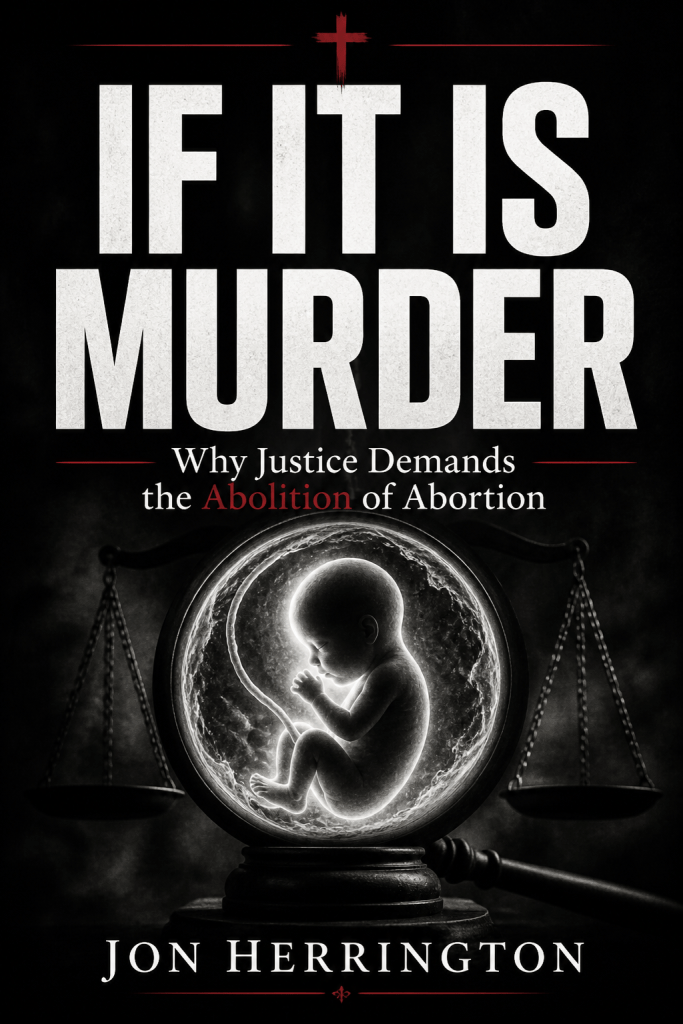
Hey, I’m Jon. I’m posting my new book, If It Is Murder: Why Justice Demands The Abolition Of Abortion, one part at a time here on my blog until it’s all published and freely available.
Once that’s done, I’ll put it up as a full book for purchase for anyone who wants it. Stay tuned here for the link to that!God bless you all, and let’s get abortion abolished!
On a completely separate note, I like to chill and play Minecraft and worship Jesus. If you like those things, come hang out: https://discord.com/invite/77WVyNxCXY
If you’re a troll, don’t come hang out. You’ll just get banned anyway so why waste everyone’s time?


Leave a comment