
One of the most effective lies in the abortion debate is also one of the laziest: that the unborn child is merely a “potential human.”
That phrase has done astonishing moral work for people who would rather not think too hard. It sounds scientific enough to impress the uninformed, soft enough to calm the conscience, and vague enough to hide the reality in question. It allows people to speak as though the being in the womb is not yet one of us, but only something that might become one of us later—if allowed to continue developing.
But that is false.
The child in the womb is not a potential human. He is a human with potential.
That distinction is not semantic trivia. It is the entire issue.
A potential human would be something that is not yet a human being but could become one under the right conditions. Sperm is potential in that sense. An egg is potential in that sense. Before fertilization, each is part of a process that may lead to the existence of a new human organism, but neither one is itself a whole human being. Neither sperm nor egg is an individual member of the human species. Neither is a complete organism directing its own integrated development toward maturity.
But once fertilization has occurred, the situation has changed completely.
At that point, what exists is not a mere possibility. It is not raw material waiting to become someone else. It is not a body part, not tissue in the abstract, not a vague “pregnancy” floating free from any subject. What exists is a new, living, distinct human organism.
That point matters so much because it cuts beneath nearly every rhetorical trick used to justify abortion. If the unborn child is already a human being, then abortion is not preventing someone from coming into existence. It is ending the life of someone who already exists.
That is a radically different moral category.
The central biological fact is simple: human development is a continuum. There is no magical moment later in pregnancy when a nonhuman becomes human. There is no sudden leap from thing to person, from tissue to child, from not-one-of-us to one-of-us. There are many stages in human development, but those stages are stages of a human life, not steps from nonhumanity into humanity.
This should not be controversial. We already understand this principle everywhere else.
A newborn is more developed than a child in the womb. A toddler is more developed than a newborn. A teenager is more developed than a toddler. An adult is more developed than a teenager.
But development does not determine what kind of being something is. A toddler is not more human than a newborn. An adult is not more human than a toddler. Greater development does not create humanity; it expresses the growth of a human being who was already there.
The same logic applies in the womb.
The embryo is not a potential human any more than an infant is a potential teenager. He is already what he is: a human being at an early stage of development.
That is why the phrase “potential human” is so deceptive. It confuses identity with maturity. It treats what the child can become in terms of growth and ability as though it determines what the child already is in terms of nature. But a being does not become human by becoming larger, stronger, more aware, more independent, more wanted, or more visible. Those changes may alter how others perceive him. They do not alter what he is.
This is one reason the argument so often slides into evasive language. People say “it’s just a clump of cells,” as though that settles something. But the phrase is almost comically empty. Yes, the unborn child is made of cells. So are you. So is every toddler, judge, surgeon, activist, professor, and politician on earth. The question is not whether the unborn consists of cells. The question is what those cells are organized as.
That is the real issue: organism, not mere material.
A human skin cell is human in the adjectival sense—it comes from a human being—but it is not itself a whole human organism. A tumor has human DNA, but it is not a human being. A body part contains human tissue, but it is not a distinct, integrated member of the human species. The unborn child is fundamentally different. He is not just human stuff. He is a whole, living, self-directed organism of the human kind.
That distinction destroys a great deal of deliberate confusion.
The embryo is not like a fingernail or kidney. He is not an appendage of the mother. He is not merely “part of her body,” even though he is located within her body and dependent upon her body. He has his own distinct biological identity, his own internal developmental trajectory, his own organized unity as a living being. He is not the mother’s liver. He is her child.
That does not mean mother and child are unrelated, of course. Their relationship is intimate and profound. The child depends on the mother in extraordinary ways. But dependence is not identity. One human being can depend entirely on another human being without becoming that other human being’s body part. Conjoined twins may share organs or systems and still be distinct individuals. A premature infant may depend on machines and caregivers for survival and still remain a distinct human being. Dependency does not erase individuality. It simply describes a condition of vulnerability.
And vulnerability is not an argument against humanity.
This is where abortion advocates often reach for other standards. If they cannot deny that the unborn is biologically human, they begin speaking instead of personhood, consciousness, viability, or sentience. We will deal with those more fully later. But even now, it is worth noticing what the move reveals. It reveals that the basic biological point is difficult to escape. If the unborn were truly not a human being, there would be no need to go searching for a second category to explain why some humans count and others do not.
The escape route changes because the first line of defense collapses.
And it does collapse.
From the earliest stage, the unborn child is alive. That much should be obvious. The dead do not grow. The dead do not develop in a coordinated, self-directed way. The dead do not proceed through the stages of maturation characteristic of a living organism. The unborn child is alive.
He is also human. Not canine, not feline, not some mysterious pre-human entity waiting for a future upgrade. Human parents generate human offspring. This is not difficult. The child in the womb is not a member of an intermediate species. He is human.
And he is distinct. He is not identical to either parent. He possesses his own biological identity as an individual organism. He may even have a different sex, different blood type, different genetic traits, and a developmental path that belongs to him as himself, not merely as an extension of his mother.
Alive. Human. Distinct.
That is not a slogan. That is the biological reality abortion rhetoric is built to conceal.
At this point, some people try to dodge the issue by appealing to appearance. The early embryo does not look like the baby in a sonogram at twenty weeks, much less like a newborn. But appearance is one of the worst possible guides to human worth. Human beings look radically different at different stages of development. A six-week embryo, a twenty-week fetus, a newborn in the NICU, a healthy toddler, and a dying old man all look different. So what? External appearance tells us something about stage, not status.
Others appeal to size. The unborn is tiny, therefore supposedly less morally significant. But size has never determined value. If it did, linebackers would have more rights than toddlers, and tall men would be morally weightier than short women. That is ridiculous. Size affects strength, not worth.
Others appeal to location. The child in the womb is inside the mother, whereas the infant is outside her. But location cannot change essence. Traveling six inches down the birth canal does not transform a nonhuman into a human being, nor does a Caesarean section confer moral status by surgical magic. If the same child is worthy of protection one moment after birth, then mere geography cannot explain why he was unworthy one moment before it.
Others appeal to level of development. But again, development is continuous. There is no bright line where the child suddenly acquires humanity. There are many measurable changes in growth, but none of them change the kind of being developing. The unborn child is not moving toward humanity; he is moving through the earliest stages of a human life.
Others appeal to dependency. But dependency is not disqualifying. Newborns are dependent. The severely disabled are dependent. The sick and elderly are dependent. A patient under anesthesia is dependent. A man on a ventilator is dependent. If dependency can cancel one human being’s right not to be intentionally killed, then it is a principle that threatens far more than the unborn.
Every one of these arguments fails for the same reason: they confuse what a human being can do, how a human being appears, or what a human being currently lacks, with what a human being is.
That confusion is deadly.
Because once human value depends on function rather than nature, some humans will always be in danger. The strong will define the standard, and the weak will fall short of it. That is not equality. It is ranking.
And the unborn child will always lose in such a system, because he is the easiest human being to rank out of protection. He is small. Hidden. Silent. Dependent. Unseen by most. Easy to rename. Easy to abstract. Easy to describe as a burden rather than a neighbor. Easy to kill without public spectacle. That is precisely why clarity here matters so much.
The unborn child does not need to perform humanity in order to possess it.
He does not need to speak in order to be one of us. He does not need to reason in order to be one of us. He does not need to survive on his own in order to be one of us. He does not need to be wanted in order to be one of us. He does not need to be visible in order to be one of us.
He only needs to be what he is.
And what he is, from the beginning, is a living human being.
Some people resist this conclusion because they think it makes the moral stakes too severe. And they are right. It does.
If the unborn child is truly a human being, then abortion cannot be a morally neutral medical procedure. It cannot be a private matter of preference. It cannot be defended as the simple removal of tissue. It becomes instead the intentional ending of a human life in its earliest and most vulnerable stage.
That is exactly why so much effort goes into muddying this point. Entire rhetorical systems have been built to stop people from speaking plainly here. They say “conception” sounds religious. They say “zygote,” “embryo,” and “fetus” sound scientific, as though scientific labels somehow cancel humanity rather than describe stages of it. But these terms do not solve the moral question. They describe age and development, not essence. “Embryo” is not the name of a nonhuman being. It is the name of a human being at the embryonic stage. “Fetus” is not a creature of another order. It is a human being at the fetal stage. To use the proper scientific term is fine. To use it as camouflage is dishonest.
We do not escape the issue by changing vocabulary.
In fact, if we are going to be scientific, then we should be consistent. Science tells us what kind of organism the unborn child is. It does not tell us that some human beings may be killed because they are less developed. That second claim is not science. It is philosophy, law, and morality layered on top of science. And once that happens, the real question returns with full force: by what principle do we divide the human family into those worth protecting and those who may be destroyed?
There is no principled answer that does not also endanger others.
That is why the simplest answer is the soundest one. Human beings deserve human rights because they are human beings. Not because they have crossed some arbitrary threshold of ability, independence, self-awareness, or social desirability. Not because they can survive without aid. Not because they can demand their rights in a courtroom. Not because they look cute in an ultrasound photo or have names chosen by excited parents. They deserve protection because they are members of the human family.
The unborn child meets that standard from the beginning.
And once that fact is admitted, the entire moral atmosphere changes.
The issue is no longer whether we prefer this pregnancy to continue. The issue is no longer whether someone feels ready. The issue is no longer whether a child’s existence creates hardship.
The issue becomes whether one human being may intentionally kill another human being because the second human being is small, hidden, dependent, and in the way.
That is the question abortion advocates spend so much time trying not to ask.
Scripture, of course, does not give us a modern embryology textbook. It was not written to do that. But Scripture does not need to provide a microscope in order to establish the moral principle that matters here: human life is not ours to treat as disposable. The God who forms life in the womb is not confused about what is there. The God who knows persons before they are born is not speaking of tissue as though it were a poetic metaphor for someone who does not yet exist. The biblical witness is entirely consistent with what biology reveals: the child in the womb is not a fiction, not an abstraction, not a mere possibility, but a real human life under the gaze of God.
That does not replace biology. It deepens the moral weight of it.
And that weight is exactly what our culture has tried so hard to evade.
Because if the unborn child is a potential human, abortion sounds like prevention. But if the unborn child is an actual human, abortion is destruction.
If the unborn child is merely tissue, abortion sounds like medicine. But if the unborn child is a distinct human organism, abortion is violence.
If the unborn child is not yet one of us, then the debate is about preference. But if the unborn child is one of us, then the debate is about justice.
That is why the battle over definitions matters. Not because definitions are sterile academic toys, but because false definitions make real victims disappear.
The child in the womb is not a potential human. He is the same kind of being you are and I am. Smaller, weaker, earlier, and hidden—but no less human for any of that.
And once that is seen clearly, another lie begins to fall apart right behind it: that even if the unborn are biologically human, they are not yet persons in the full moral sense.
That argument is next. And it is every bit as arbitrary, selective, and dangerous as it sounds.
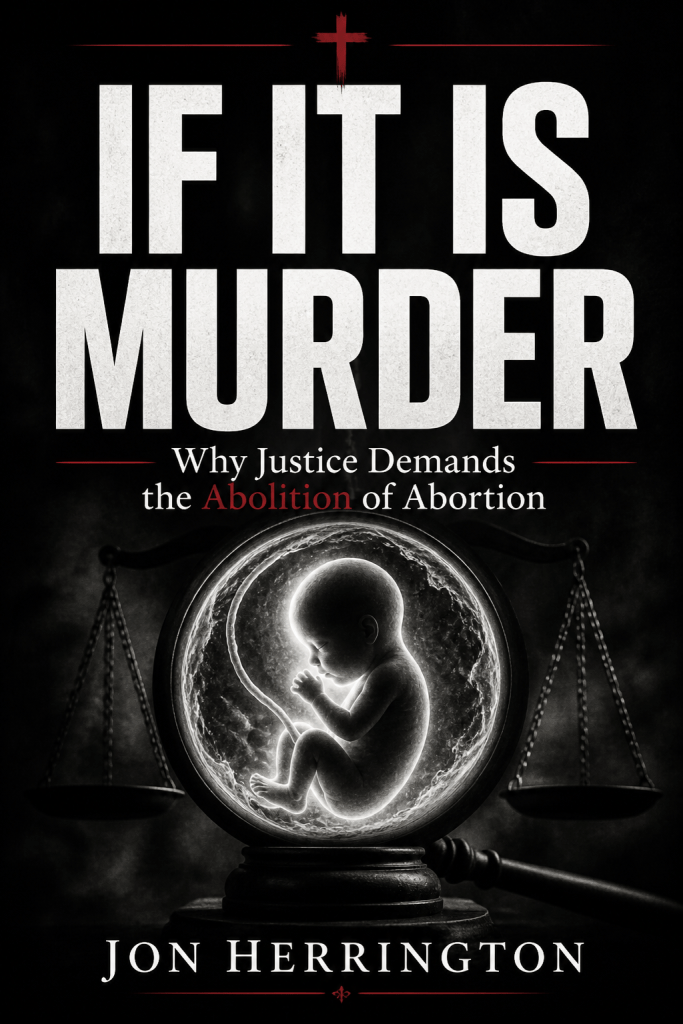
Hey, I’m Jon. I’m posting my new book, If It Is Murder: Why Justice Demands The Abolition Of Abortion, one part at a time here on my blog until it’s all published and freely available.
Once that’s done, I’ll put it up as a full book for purchase for anyone who wants it. Stay tuned here for the link to that!
God bless you all, and let’s get abortion abolished!
On a completely separate note, I like to chill and play Minecraft and worship Jesus. If you like those things, come hang out: https://discord.com/invite/77WVyNxCXY
If you’re a troll, don’t come hang out. You’ll just get banned anyway so why waste everyone’s time?


Leave a comment